
Since OpenAI officially launched ChatGPT in November 2022, artificial intelligence (AI) has become the hottest investment trend. While a broad range of companies have benefited from the rise of AI, Nvidia has distinguished itself as both the most widely discussed and among the most significantly impacted. In July of this year, Nvidia became the first company to surpass a $4 trillion market capitalization. More recently, Oracle made headlines by securing a $300 billion contract from OpenAI for computing power. Which is the largest cloud computing contract in history. All in all, we’ve seen both the hype surrounding AI and the massive capital being poured in to support it. These kinds of market narratives and technological revolutions are nothing new in the history of the stock market. Every era has had its defining theme—shaping investor sentiment and directing capital towards innovation and growth.
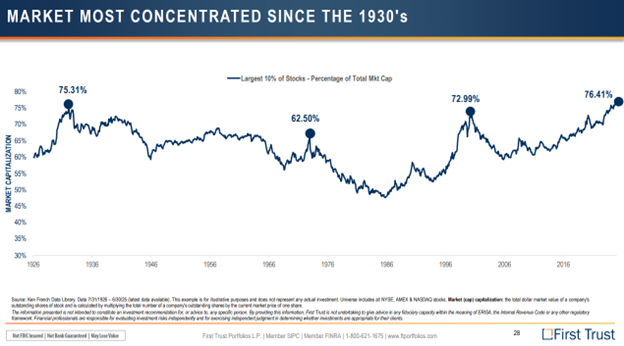
The stock market runs on stories, and throughout history, certain themes have consistently driven it higher. In the 1980s and 1990s, a major driver was the consumer and retail boom. This period saw Baby Boomers entering their peak earning years, alongside a significant rise in female labor force participation. As dual-income households became more common, disposable income increased—fueling a surge in consumer spending and retail growth. Walmart and Target were revolutionizing retail, driving growth in retail stocks, transforming branding strategies, and cementing the dominance of big-box stores. From the mid-1990s to 2000, the Dot-Com boom and the rise of the internet dominated the market narrative. Digital transformation and growing connectivity fueled a surge in venture capital, leading to high valuations for tech start-ups. This era saw the emergence of companies like Amazon, eBay, and Google. Markets soared on optimism—only to crash abruptly when the bubble burst. Next came the era of mobile phones and cloud computing. Innovations like the iPhone, Amazon Web Services, and Facebook fueled the rise of mobile computing, cloud infrastructure, and social media. Then emerged the latest market-driving theme: artificial intelligence. Powering AI is a massive demand for semiconductors and data centers, needed to train large language models (LLMs)—with ChatGPT being the most well-known example. Since the launch of ChatGPT, the top 10 stocks have dramatically outperformed the broader market, largely driven by their heavy exposure to the AI theme. The chart below highlights this widening gap in historical context.
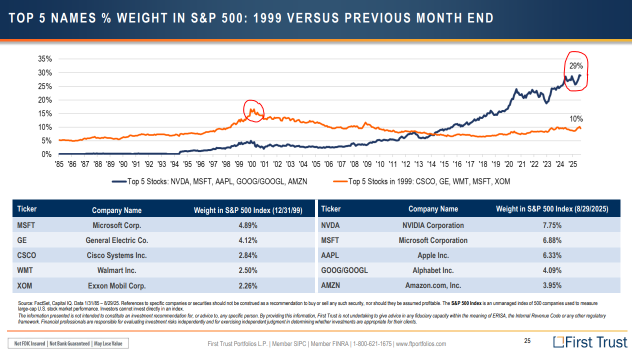
Throughout the stock market’s history, we see recurring patterns. Every expansion cycle is driven by a thematic story—often fueled by a compelling narrative and a major technological or demographic shift. These themes often drive valuation expansion as investors begin pricing in future potential, which in turn leads to increased speculation in the stocks of companies closely tied to the narrative. This dynamic is one reason why the current market cycle is frequently compared to the Dot-Com boom, with many suggesting we may be in another market “bubble.” A market bubble refers to a period when asset prices, such as stocks, become significantly overvalued relative to the underlying businesses’ earnings and cash flows. Such bubbles are typically fueled by heightened investor enthusiasm and speculative behavior. The chart below illustrates how these patterns can reemerge. Today, tech stocks account for a record 37% of the total U.S. stock market—surpassing even the peak of the Dot-Com bubble in 2000. A similar pattern appears in the chart below, which tracks the top five S&P 500 companies as a share of the overall market. Unlike in 1999, however, today’s top five names represent a much larger portion.
Patterns can sometimes appear easy to follow, but they can also lead to incorrect inferences when drawing conclusions. Just because something looks or feels similar to past events doesn’t mean it will produce the same outcome. The Dot-Com bubble was marked by a surge of public offerings from brand- new companies, many of which were valued at absurdly high multiples based purely on their potential future earnings. This is not the case today. While the tech sector is currently trading at 29.5 times forward earnings—still high by historical standards—it’s far more reasonable than the nearly 50 times seen at the peak of the Dot-Com bubble in 2000. To put it simply, a company trading at 29 times forward earnings means investors are paying $29 today for every $1 the company is expected to earn over the next year.
With recent earnings reports highlighting how AI has influenced spending among the major tech giants, with forecasts projecting continued growth through 2030. The demand for this technology is clear and the company leading the charge, Nvidia, has the earnings reports to back it up. This marks one of the key differences between today’s market environment and the Dot-Com era: the current leaders are not just riding hype; they’re generating real profits.
The bigger-picture idea I’m getting at is that when it comes to investing in the stock market, the best and most reliable strategy is to invest for the long-term. Trying to consistently time the market or chase only the latest trendy companies isn’t a strategy worth relying on. Throughout its history, the market has moved in cycles, often driven by overarching themes or narratives. What’s often overlooked is that investing has a deeply human and emotional side. As humans, we’re quick to spot patterns and use them to make sense of the world around us. And behind every market story, there are always two sides: the believers and the skeptics. Just like in many areas of life, it’s hard not to pick a side. But the beauty of investing is that you don’t have to. A smart approach doesn’t rely on taking an “all or nothing” stance. Instead, diversification allows you to stay balanced—helping you avoid the regret of missing out and the disappointment of being completely wrong. Navigating the stock market on your own can be overwhelming, especially with constant changes and uncertainty. That’s why consulting a qualified financial advisor is so important. We can help ensure your portfolio stays aligned with your long-term goals and guide you in making informed investment decisions.
Sources:
https://www.reuters.com/markets/europe/is-todays-ai-boom-bigger-than-dotcom-bubble-2025-07-22
Factor Returns (ftportfolios.com) – First Trust Slides