

On July 4, 2025, President Trump signed into law the legislation popularly known as the One Big Beautiful Bill Act (OBBBA). Prior to the bill being passed there were strong opinions regarding the US fiscal and deficit situation. As of July the total U.S. national debt sits at approximately $36.66 trillion. Based on recent projections, the OBBBA is expected to add another $4 – $5 trillion in deficits over the next decade.
This has raised growing concerns about the long-term fiscal sustainability of the U.S. government. In May of this year, before the bill was enacted, Moody’s downgraded U.S. sovereign credit to Aa1—one level below its highest rating of Aaa. With this move, Moody’s became the last of the major credit rating agencies to issue a downgrade, following similar actions by Standard & Poor’s in 2011 and Fitch in 2023.
The bond markets have responded accordingly. The yield on the U.S. 30-year Treasury has surpassed 5%, a significant milestone given the role long-term bond yields play in the broader economy. These yields serve as a foundation for key financial benchmarks, influencing the cost of capital, mortgage rates, and overall market risk appetite.
Inflation remains a key concern for investors in light of the unsustainable trajectory of U.S. debt. Issuing additional debt to finance economic growth and cover interest payments on existing liabilities may intensify inflationary pressures throughout the economy. That said, since the Global Financial Crisis in 2008, U.S. annual inflation remained relatively low—below 3%—until it surged to nearly 5% in 2021 and peaked at around 8% in 2022. The country experienced a decade of low inflation, followed by a sharp spike over the past three years.
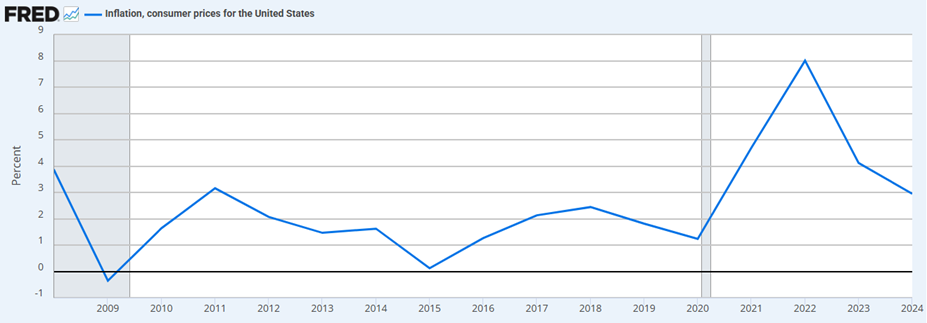
During this period, the United States ran budget deficits without triggering significant inflation. However, this does not imply that issuing more debt is without inflationary consequences. The COVID-19 pandemic illustrated how large-scale deficit spending and money creation can contribute to inflation. At that time, the U.S. recorded its largest-ever budget deficit, and the accompanying surge in money supply was a key factor in the inflationary pressures that followed. More recently, the trajectory of the federal budget deficit has become a growing concern, viewed by many economists as more troubling than the overall level of U.S. national debt.
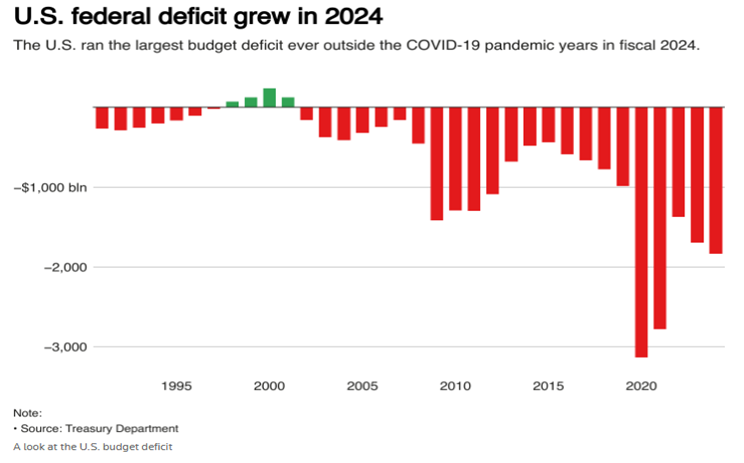
In addition to inflation, the yield curve has become a growing area of concern for investors. As the U.S. government continues to issue debt to finance its deficits, investor demand for Treasury securities must remain strong to prevent yields from rising further. As previously noted, Treasury yields have widespread effects across the economy, often increasing borrowing costs for consumers. This impact is already evident in the housing market, which has slowed considerably as prospective buyers face mortgage rates in the 6% to 7% range. The result has been a notable decline in home purchase activity, particularly among first-time buyers.
From 2008 to 2020, a period characterized by relatively low inflation, the Federal Reserve employed a monetary policy known as quantitative easing (QE). Under QE, the Fed created money to purchase financial assets—primarily U.S. Treasury bonds—from banks and other institutions. This approach was used to stimulate the economy when traditional interest rate cuts were no longer effective. With rates near zero following the 2008 Global Financial Crisis, the Fed had limited room to ease policy further. By buying long-term Treasuries, the Fed injected liquidity into financial markets and helped lower long-term interest rates, encouraging borrowing, investment, and economic growth.
The Federal Reserve officially ended QE in early 2022, following the COVID-19 pandemic. Since then, some investors have expressed concerns about weakening demand for longer-term U.S. debt. In response, yields may rise as investors seek higher returns to compensate for perceived increases in risk. Despite these challenges, U.S. Treasuries remain a cornerstone of the global financial system. The U.S. continues to benefit from the dollar’s status as the world’s primary reserve currency, and Treasuries are still widely regarded as the safest assets available. As such, demand is expected to remain strong unless a viable alternative emerges.
Given this complex environment, it is essential to evaluate a wide range of economic risks and variables when developing a long-term investment strategy. While the U.S. economy remains dynamic, it is not immune to structural vulnerabilities. The passage of the One Big Beautiful Bill Act (OBBBA) does not indicate an imminent fiscal crisis but reflects a continued reliance on deficit spending as a means of fostering economic growth. Whether this strategy proves effective remains to be seen. However, understanding how the OBBBA may affect investments, tax liabilities, and retirement planning is critical. Establishing a clear financial strategy is essential, and consulting a qualified financial advisor can help ensure alignment with long-term goals in light of potential policy impacts.