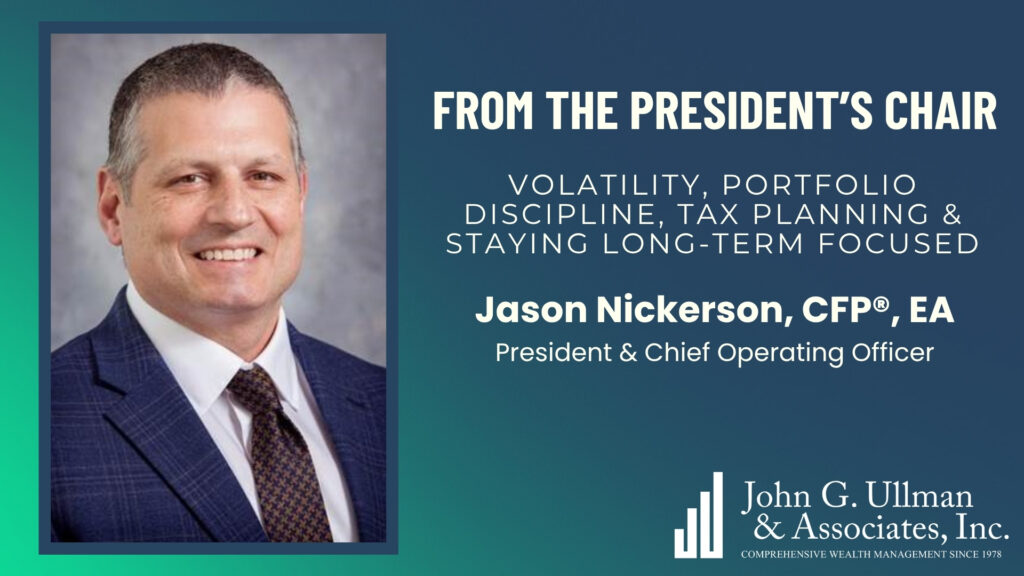
Interview with Jason Nickerson, CFP®, EA – President & COO, John G. Ullman & Associates, Inc.
This interview has been edited for length and clarity.
Q: Q1 is often about setting the tone for the year. What has stood out to you most through the first few months of 2026?
Jason Nickerson:
From a high-level perspective, Q1 followed a very strong second half of 2025, but we entered 2026 with renewed volatility. What’s interesting—and a bit eerie—is how similar the start of 2025 and 2026 have been. In both years, markets started strong, experienced a pullback for different reasons, and then rebounded.
As we sit here now, markets are near—or even at—all-time highs again. It’s a reminder that while volatility is present, markets have continued to show resilience. Of course, we don’t know what the rest of 2026 will bring, but it’s been another start marked by swings in both directions.
From a firm-specific standpoint, Q1 is about wrapping up the prior year—finalizing the compliance side of 2025, particularly around tax filing. It also kicked off the year with strong overall portfolio performance for many clients. At the same time, we’ve been focused on managing investment risk as markets have pushed higher, ensuring portfolios don’t drift too far from their intended strategy.
On the planning side—especially taxes—we’re now seeing the real impact of last year’s tax law changes reflected in client returns. That gives us a clearer picture of how to plan more effectively for 2026.
Q: As we move into Q2, what planning opportunities should clients be thinking about early in the year?
Jason Nickerson:
There are a few key areas of focus. First is investment allocation. With such strong performance over the past few years, it’s easy for portfolios—whether managed by us, held in employer plans, or self-directed—to become overweight in equities.
That makes portfolio management and risk planning especially important right now. We’ve been working with clients to scale back risk where appropriate and bring portfolios back in line with their long-term strategy.
Another area is continued implementation of last year’s tax law changes. While we’ve now seen their impact through tax returns, there are still planning opportunities—and limitations, particularly around income thresholds—that we need to actively manage throughout the year. This becomes more complex when markets are at highs and realizing gains can have tax implications.
Beyond that, strong market performance has likely had a positive impact on many long-term plans—whether for retirement, education, or legacy goals. This is a good time to reassess: Has anything materially changed? Are we ahead of plan? And how should that influence decisions moving forward?
Q: With so much focus on short-term headlines and volatility, how do you help clients maintain a long-term perspective?
Jason Nickerson:
There’s a quote I recently came across: “Markets move fast, but long-term plans shouldn’t.” That really resonates.
Markets today react faster than ever due to the 24/7 news cycle, increased access to information, and the rise of individual investors. But that doesn’t mean financial plans should move at the same speed.
Investment fundamentals still matter. If we stay grounded in those principles, it becomes much easier for clients to maintain a long-term perspective. We’ve built plans with a purpose—and those plans shouldn’t be constantly adjusted based on short-term market movements.
It’s similar to trying to time the market—which we advise against. Trying to “time” your financial plan based on short-term events can be just as damaging. Regular reviews are important to ensure you’re on track, but making major changes based on temporary conditions can disrupt an otherwise solid long-term strategy.
Q: Now that we’re a quarter of the way through 2026, how would you summarize your outlook for the rest of the year?
Jason Nickerson:
I would start by encouraging clients to recognize how well things have gone recently—despite how volatile the world may feel. Markets have performed well over the past few years, and the recent tax law changes have provided clarity and, in many cases, favorable outcomes for individuals.
That said, it’s important to stay grounded. Keep your eye on the long-term plan. Live for today, but plan for tomorrow. Not everything needs to change just because the world feels fast-moving or uncertain.
In fact, this may be a time to take a more contrarian mindset. When markets are performing well and it feels like you can’t make a wrong decision, that’s often when risk management becomes most important. Markets can and do reverse, sometimes quickly, and there are still underlying economic concerns that could drive that.
So, the message is simple: focus on protection first, growth second. We work hard to build wealth and financial security—it’s just as important to protect it. In strong markets, it’s easy to get caught up in chasing growth and forget about risk. But maintaining that balance remains critical to long-term success.
About John G. Ullman & Associates, Inc.
John G. Ullman & Associates, Inc., was founded in Corning, N.Y., in 1978. The firm is a Registered Investment Advisor (RIA) registered federally with the Securities & Exchange Commission*. As an independent, fee-based investment management firm, JGUA provides comprehensive wealth management strategies and services to clients. The firm manages over $1 billion in client assets, with a staff of more than 70 employees across four locations: Horseheads, N.Y., Rhinebeck, N.Y., Charlotte, N.C., and Corning, N.Y.
If you are interested in learning more about how JGUA could help you, visit our website here, or call 1 (800) 936-3785. You can follow us on LinkedIn, Twitter, Facebook, Instagram, YouTube, and The JGUA Blog.
*Registration does not imply a certain level of skill or training.